skip to main |
skip to sidebar
 Montage of Fort Leonard Wood, MissouriFort Leonard Wood is approximately an hour and a half scenic drive from Atlantis Island Condos and is a “must do” day trip for military history buffs. Originally a basic training center in 1940, today Ft. Wood is the only installation that is home to three Army Schools. The installation represents all branches of service, Army, Marine Corp, Navy, Air Force, and Coast Guard.
 John B. Mahaffey Museum Complex, located at 495 South Dakota Avenue, Fort Leonard WoodThe John B. Mahaffey Museum Complex, located at 495 South Dakota Avenue, Fort Leonard Wood, is home to four museums, that are open to the public, and have no admission fees. The four museums document the history of the fort itself, as well as the history of each of the three Army Schools.
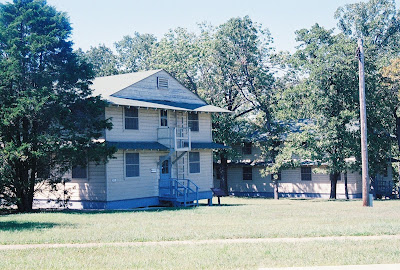 Restored World War II BuildingsThe Fort Leonard Wood Museum was established more than 25 years ago and features artifacts from the post’s past. The highlight of this museum is the collection of World War II barracks that depict life at Fort Leonard Wood since the Second World War. Twelve World War II buildings were set aside to preserve the past for future visitors. These buildings include four barracks, two mess halls, three day rooms, two orderly rooms, and a regimental commanders quarters. Exhibits also include artifacts of the Axis prisoner of war camp that housed Italian and German prisoners of war during World War II. This museum also documents the life of the installation’s namesake, Major General Leonard Wood. Major General Leonard Wood was a Medal of Honor recipient, Military Governor of Cuba, and Governor General of the Philippines. In 1910 he was named Chief of Staff of the United States Army, and held this position until 1914. A physician, he is the only medical officer to have ever been named to the Army Chief of Staff position. Fort George G. Meade in Maryland was temporarily renamed Fort Leonard Wood in his honor during the 1920’s but reverted back to it’s current name in the 1930’s. Groundbreaking for Fort Leonard Wood, Missouri was December 3, 1940 and the installation has always retained Major General Leonard Wood as it’s namesake.
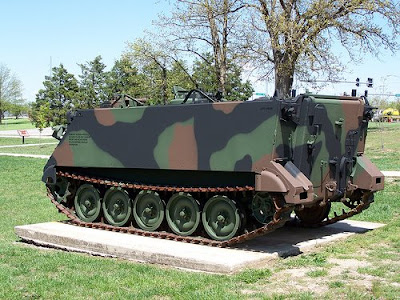 M113A3 Armored Personnel CarrierThe US Army Engineer Museum was established in 1989, as part of the relocation of the Engineer School from Fort Belvoir, Virginia to Fort Leonard Wood, Missouri. The museum highlights five aspects of the Army’s engineering mission:
Topographic Engineering
Land-Mine Warfare
Tactical Bridging
Demolitions & Explosives
Arms & Ammunition
 US Army Chemical Corps Museum Exhibit
The US Army Chemical Corps Museum was relocated from Fort McClellan, Alabama to Fort Leonard Wood, Missouri in 1999. The museum is divided into six separate galleries:
First World War Gallery
Second World War Gallery
Cold War Gallery
New World Order Gallery
Topical Gallery
Temporary Gallery: The temporary gallery has featured the Second Chemical Mortar Battalion exhibit since October 2004.
June 2008 was the 90th anniversary of the Chemical Corps and also the 10th anniversary of the Civil Support Teams. The Chemical Corps Museum dedicated a new exhibit June 24, 2008 to honor the history of the Civil Support Team.
 U.S. Army Military Police Corps Regimental Museum Exhibit
The U.S. Army Military Police Corps Regimental Museum was originally located at Fort Gordon, Georgia and was relocated to Fort McClellan, Alabama in 1975. The museum, along with the United States Army Military Police School, was moved to Fort Leonard Wood, Missouri in 1999 due to the closing of Fort McClellan under the 1995 Base Realignment and Closure’s (BRAC) recommendation. The mission of the museum is “ to collect and preserve the material history of the Military Police of the U.S. Army from 1775 to present. The museum also promotes the heritage and traditions of the Military Police branch and the values of the U.S. Army to Soldiers and civilians through public exhibits, educational programs, and branch training support.”
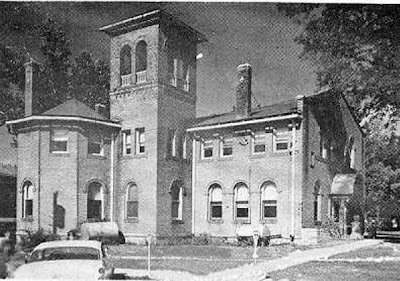 1903 Pulaski County Missouri Courthouse
The Pulaski County Courthouse Museum, located in nearby Waynesville, on historic Route 66, also houses an exhibit of interest to military history buffs. The museum features a war room that features military memorabilia from 1776 to the present, with uniforms and items from Fort Leonard Wood.

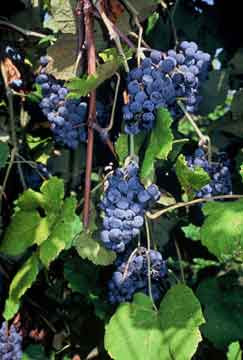 Missouri vintners have been growing grapes and making wine for a century and a half. Tens of thousands of immigrants from Germany, France, Switzerland, and Austria began pioneering to the state as early as 1821. Missouri offered the promises of fertile soil and plentiful game. Abundant timber and waterways, cheap land, low taxes, and political freedom also sweetened the pot. German immigration boomed in the 1830’s after Godfried Duden returned to Germany, after establishing a farm near present day Dutzow and traveling Missouri, and published a report extolling settling in Missouri. Luckily for us, some of these “followers of Duden”, carried carefully-wrapped clippings from their old world vineyards.
Missouri has seven distinct wine producing regions. The Augusta, Hermann, Ozark Highlands, and Ozark Mountains regions are official American Viticultural Areas. The Lake of the Ozarks is most closely associated as a part of the Ozark Highlands region and also includes the Central Wine region.
Atlantis Island Condos recommends a local four stop wine tour. This trip will take you through historic Linn Creek (Seven Springs Winery), Camden County’s seat of Camdenton (Casa De Loco Winery), the quaint town of Stover (Grey Bear Vineyard’s & Winery), and the location of one of the first battles of the Civil War, Cole Camp (Eichenberg Winery).
View Larger MapSeven Springs Winery website states “Come for the wine, Stay for the atmosphere, Remember the view!”. The wine tasting at Seven Springs will set you back $7, but includes a souvenir wine glass. The winery is home to nine different wines, Sangria Rojo, Concord Grape Juice, and Boulevard Beer for those who prefer grain over grapes. Menu options include selections of appetizers, lite fare, paninis, hand rolls, salads, and specialty soups and the suggested pairings make it easy to choose a wine by the glass or the bottle.
Casa De Loco Winery offers scenic views of the Big Niangua river from a property that has a colorful past. Originally a private fishing resort for wealthy St. Louisian’s the property took a spin as a health care facility for the elderly and the mentally ill during the 1970’s. Hence the name, meaning “house of the crazy”. In addition to wine tastings, Casa De Loco also plays host to Murder Mystery Dinner Theater every other Wednesday night through November.  Grey Bear Vineyards & WineryGrey Bear Vineyards & Winery has roots in Colorado. The winery itself is architecturally intruiging. The Deltec Home design of round open space can withstand hurricane force winds. This is a popular design style along the coasts but are rare this far inland. The winery offers seventeen wines. Vintner David Fansler has won several awards in both Colorado and Missouri.
 Eichenberg Winery started as a grandfather’s way to recreate a portion of his childhood for his grandchildren. Rodger Leutjen recalled playing with his cousins in the tunnels and mazes of the grape wines. The winery building itself was built in the early 1900’s as a blacksmith shop and has been nominated for the National Historic Register. Eichenberg offers ten wine varieties.


 Posts